01
Describe the episode
Report what was observed, including changes in movement, awareness, behavior, responsiveness, and recovery.
DSEF · Free educational evaluation
DSEF guides you through structured questions about a reported episode in someone living with dementia, including what was observed, timing, responsiveness, recurrence, recovery, and relevant context. It compares the combined pattern with published dementia-seizure research and produces a free educational report showing what shaped the result, what information is missing, and which sources support it. Use the report to prepare for a more informed conversation or clinical review. It cannot diagnose or rule out a seizure.
Free to use. No account or installation. Evidence-linked sources included.
Start immediately in your browser, or request access through WhatsApp for a more flexible experience.
Open DSEF on a phone, tablet, or computer. No account, installation, or cost.
Access DSEF through WhatsApp from anywhere.
WhatsApp use is subject to WhatsApp's own privacy terms. See the Seagull Health Privacy Policy.
Answer structured questions about the episode. DSEF checks whether enough information is available, compares the complete pattern with published research, and explains the result in plain language.
Report what was observed, including changes in movement, awareness, behavior, responsiveness, and recovery.
Answer questions about timing, recurrence, sleep, history, medication context, and what remains unknown.
DSEF applies versioned, evidence-linked rules to the complete reported pattern.
See separate Research Match and Concern & Timing findings, missing information, supporting sources, and general guidance.
Rule-based and reproducible. The same submitted information produces the same result. DSEF does not use generative AI to evaluate your answers.
DSEF uses the DSS Framework to ask about four kinds of observation: recognized seizure events, movement changes, awareness changes, and behavioral changes. One episode may involve more than one area. DSS describes what was observed without deciding the cause.
Explore the DSS Framework →Your DSEF report explains the two findings separately, shows which observations and context shaped them, identifies important information that is missing, and links the supporting research.
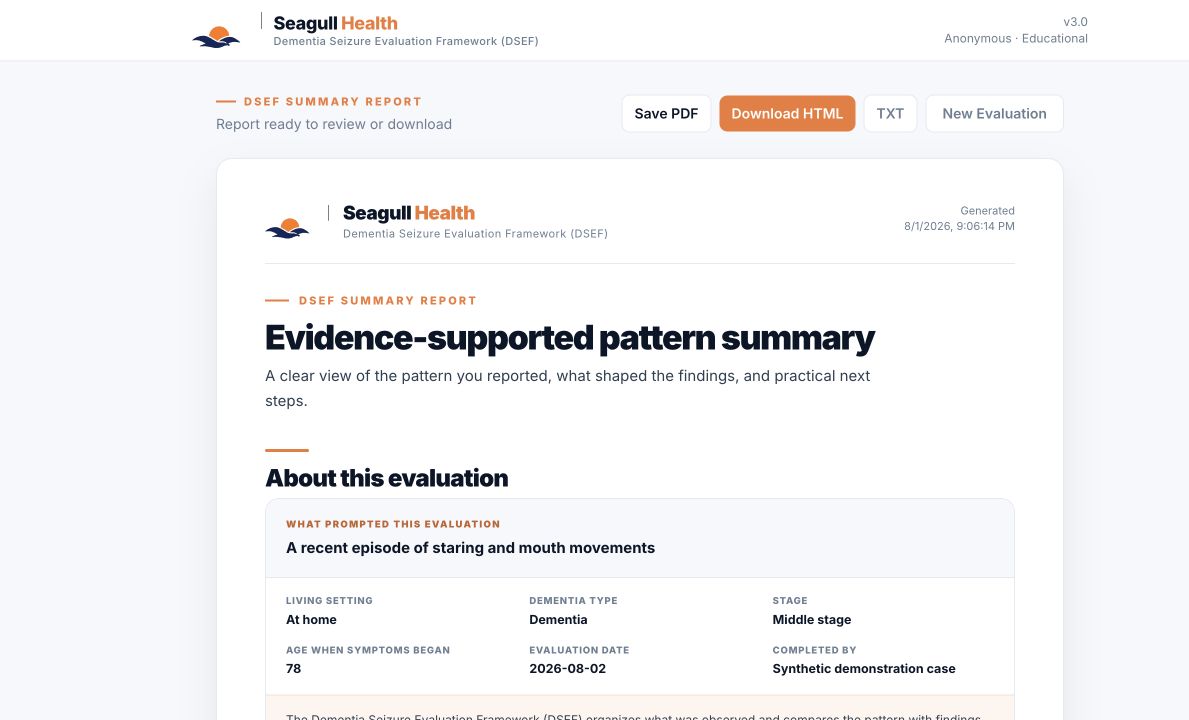
Synthetic example. No real person or identifying information is represented.
Research Match describes alignment with seizure-associated patterns represented in the literature; it is not a probability. Concern & Timing is rule-triggered educational guidance; it is not validated clinical triage.
The report identifies the observations that contributed to the findings and explains in plain language why they matter.
Missing and unknown details remain visible so you can understand the limits of the evaluation and what may need clarification.
SeizureSafe™ guidance covers Recognize, Respond, Document, and Advocate. It does not replace emergency or clinical protocols.
Supporting publications are named with clickable DOI or PubMed links. The complete report can be saved as PDF or downloaded as HTML or TXT.
Use DSEF to prepare a clearer account for a conversation or clinical review. It can organize reported observations, identify missing information, compare the complete pattern with published research, and provide supporting sources and general guidance.
DSEF cannot detect, confirm, predict, or rule out a seizure. It does not provide an individual probability, recommend treatment, or replace emergency protocols, clinical judgment, neurological evaluation, or a conversation with a qualified professional.
DSEF does not ask for names or direct identifiers. Do not enter PHI, patient identifiers, or identifying details in free-text fields. Submitted responses may be stored as described in the Seagull Health Privacy Policy.